

Facebook | X | Instagram | YouTube | LinkedIn | Threads | TikTok
BLUF
From June 11 through July 19, the World Cup will place the largest sustained crowd-density window in modern American history across eleven U.S. host cities. The realistic terror threat is not a sophisticated assault on a hardened stadium but a lone actor or small cell striking soft targets such as fan zones, transit hubs, bars, and watch parties, paired with disruption campaigns built to cause panic. If you live in or near a host city, raise your personal readiness posture and keep it raised for the duration.
Key Judgments
Highly Likely: Lone actors and small cells inspired by foreign terror organizations will view World Cup crowds in U.S. host cities as attractive soft targets.
Likely: Low-technology attack methods, including vehicle ramming, edged weapons, and small-arms assault, will present a greater real-world risk than complex coordinated plots.
Likely: Disruption operations such as swatting, hoax threats, and cyber attacks against travel and transit systems will occur in or near host cities and can trigger deadly crowd-crush events even with no real attacker present.
Likely: Iranian state-aligned actors and online incitement networks will use the tournament to amplify radicalization and recruitment, raising the baseline threat across the host environment.
Possible: A homegrown extremist already radicalized online will attempt an attack on or near a match day before the tournament concludes.
Situation Summary
The 2026 World Cup is the first 48-team, three-nation tournament in the event’s history, co-hosted by the United States, Canada, and Mexico. It runs from June 11 to July 19 and spans 104 matches, with 78 of those played on American soil across eleven U.S. cities. The tournament will draw several million international visitors, and the human concentration extends far beyond the stadiums themselves. Fan zones, public viewing areas, entertainment districts, hotels, airports, and rail and transit corridors will hold dense crowds for weeks at a time.
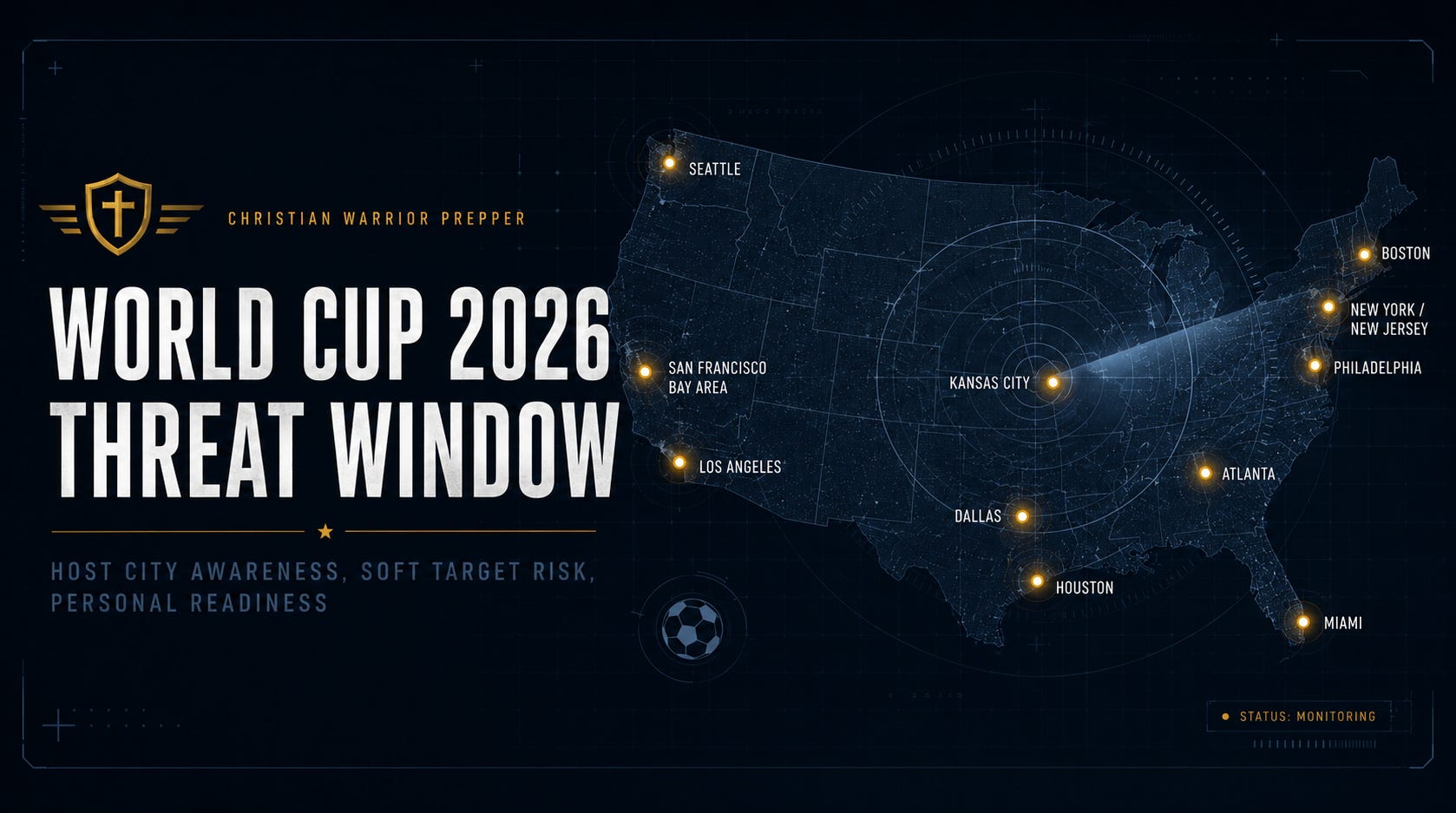
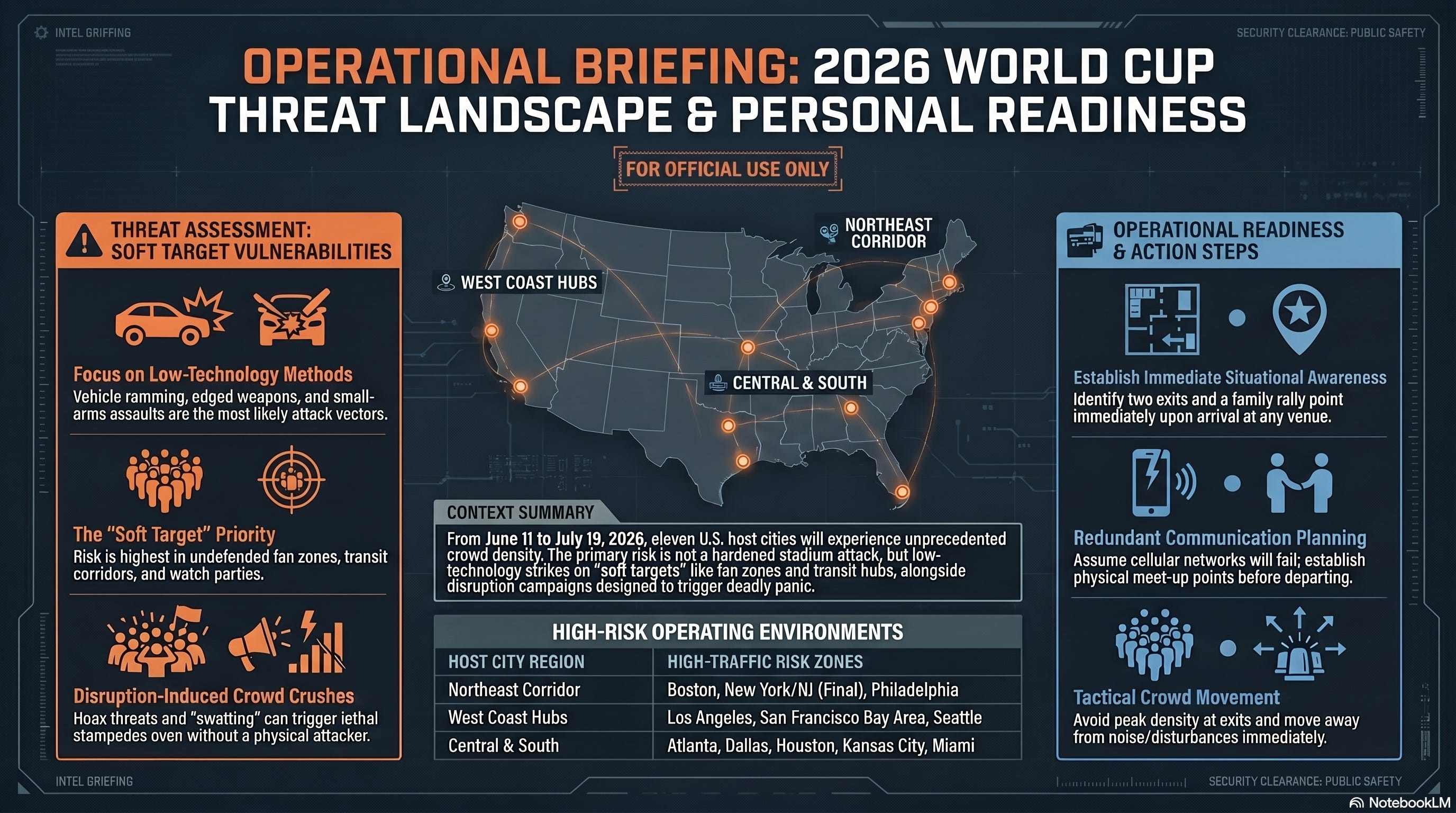
The eleven U.S. host cities are Atlanta, Boston, Dallas, Houston, Kansas City, Los Angeles, Miami, New York/New Jersey (the final will be played at MetLife Stadium in East Rutherford), Philadelphia, the San Francisco Bay Area, and Seattle. The two Canadian host cities are Toronto and Vancouver, and the three Mexican host cities are Mexico City, Monterrey, and Guadalajara.
If you live in or regularly travel through any of these regions, you are inside the operating environment for the next seven weeks. The exposure is not limited to people who buy match tickets. A family watching a game at a downtown bar, a commuter passing through an airport, and a congregation hosting a viewing event are all standing in the same target-rich window.
Threat Vectors
The methods most consistent with the current threat picture, in order of realistic likelihood, are:
Vehicle ramming into crowds. A vehicle driven into a packed fan zone, sidewalk, or pedestrian corridor requires no special skill, no weapon, and no accomplice. It remains the preferred low-cost method for inspired attackers and produces mass casualties in seconds.
Lone-actor armed assault. A single shooter targeting a crowded soft location near a stadium, transit station, or watch venue. This is the active-shooter scenario applied to an outdoor festival footprint rather than an enclosed building.
Edged-weapon attacks in dense crowds. Knife and blade attacks against tightly packed pedestrians, common in soft-target strikes overseas and difficult to stop early in a crowd.
Improvised explosive devices against mass gatherings. Lower probability inside the United States, but the model is well established internationally and fan zones present the conditions attackers seek.
Hoax and disruption operations. Swatting calls, false bomb threats, and fake active-shooter reports directed at crowded attractions. These are designed to drain law enforcement, sow confusion, and trigger stampedes. A crowd crush from a false alarm can kill as effectively as an attacker.
Cyber disruption of travel and infrastructure. Denial-of-service attacks on airport and transit websites, and manipulation of internet-connected operational systems, intended to create logistical chaos and erode public confidence rather than cause direct casualties.
Threat Actors
The people most likely to act fall into a few clear categories, and understanding who they are helps you understand how they think.
The first and most realistic threat is the homegrown violent extremist. This is an individual radicalized online, often through social media, who reaches the point of acting alone or with one or two others. Recent counterterrorism arrests across North America show this pipeline is active and that platforms continue to drive radicalization and incitement. These actors rarely possess advanced capability, which is precisely why they favor low-technology methods against undefended crowds.
The second is the Iranian state and its aligned networks. Open-source reporting points to Iranian-linked incitement that frames the tournament as an opportunity to strike at the United States and to exploit the influx of international travelers for infiltration and recruitment. This thread is amplified by coordinated influence operations, including official diplomatic accounts and state media, that are working to inject grievance and instability narratives into the World Cup conversation. Heightened tension between the United States, Israel, and Iran raises this baseline.
The third is the nihilistic online subculture responsible for swatting and hoax-threat campaigns. These groups are not motivated by ideology in the traditional sense. They seek notoriety and chaos, and they have demonstrated a willingness to target high-traffic public spaces such as zoos, schools, and cultural sites. Their disruption can produce real casualties through panic and crowd crush.
The fourth is the hacktivist and state-influence layer. Pro-Palestinian hacktivist groups have already claimed cyber strikes against host-city infrastructure, and Russian and Iranian state media are running parallel narrative campaigns to portray the tournament as unsafe or illegitimate. Their goal is destabilization and erosion of public trust, not direct physical harm, but the confusion they create degrades the security environment for everyone.
The fifth, and worth naming for families specifically, is the opportunistic criminal element. Large transient crowds attract theft, fraud, and assault that have nothing to do with terrorism but can put you and your family in harm’s way just the same.

Action Steps
These steps are written for individuals and families, not for security teams. They cost nothing and apply whether you are at a match, a watch party, or simply moving through a host city.
Accept that you are in a target-rich environment, and run your head up and your phone down in any crowd. Most victims never saw the threat develop.
On arrival at any venue, fan zone, bar, or transit hub, locate at least two exits and a rally point before you settle in. Do this every time, automatically.
Avoid the densest crush points. Entrances, chokepoints, and the surge of people leaving after a goal or a final whistle are where crowd-crush deaths happen. Hang back and let the press thin out.
Build a family communications plan before you go out. Pick a meet-up point in case you are separated, and assume cell networks will be saturated or down when you need them most.
Rehearse a simple decision with your family in advance. If something happens, the plan is to move away from the noise and toward an exit, get low and behind cover if you cannot run, and fight only as a last resort. Children should know the meet-up point.
Carry a low-profile, useful kit. A tourniquet you know how to use, a small flashlight, a charged phone, and cash. Nothing that draws attention or creates a problem at a security screening.
Learn the behavioral indicators of a person preparing to act, and report what you see. Trust the instinct that tells you something is wrong, and move first, explain later.
Stay out of political flashpoints. Flag disputes, demonstrations near certain national teams, and counter-protests can turn violent fast. Disengage and leave the area.
Plan a backup route home. Expect that a swatting incident or cyber disruption could shut down a transit line or an airport with no warning, and have a second way out.
If your congregation is hosting a watch event, designate one person to control access and watch the room, and brief your plan before the crowd arrives.
Threat Indicators
Watch for these signals as the tournament approaches and progresses:
Spikes in online incitement tied to specific match dates, particularly matches involving the United States or politically sensitive teams.
Escalation in swatting and hoax-threat campaigns against public venues in the weeks before and during the tournament.
Any shift in extremist chatter from grievance language to operational or logistical detail, such as discussion of travel, targets, or timing.
Cyber disruptions affecting airports, transit websites, or public-facing host-city systems.
Reports of diaspora mobilization or confrontation tied to specific national teams and their training locations.
Threat Assessment
The overall environment surrounding the 2026 World Cup is elevated, but as of this writing there is no confirmed, credible plot against any specific venue. That distinction is important and should shape how you respond. The dominant danger is not a movie-style coordinated attack on a stadium. It is the lone actor or small cell striking an undefended crowd with a simple method, and the disruption operation that turns a false alarm into a deadly stampede. Both are Likely across the seven-week window, and both are most dangerous in the soft-target space around the matches rather than inside the secured stadium perimeter.
Iranian state-aligned incitement and the broader influence-operation layer raise the radicalization baseline and make a Possible homegrown attack more probable than it would be in a normal summer. The cyber and hacktivist activity is real but is most likely to produce confusion and resource strain rather than direct casualties, though that confusion can be deadly if it triggers panic in a packed crowd. For a family living in or traveling through a host city, the correct posture is steady, sustained personal readiness. Not fear, and not paralysis. You move through these weeks aware that the environment has changed, you keep your habits sharp, and you keep your people close.
Biblical Lens
Ezekiel 33:4-5 (ESV): “then if anyone who hears the sound of the trumpet does not take warning, and the sword comes and takes him away, his blood shall be upon his own head. He heard the sound of the trumpet and did not take warning; his blood shall be upon himself. But if he had taken warning, he would have saved his life.”
In Ezekiel’s day the watchman stood on the wall, saw the threat approaching, and sounded the trumpet so the people could prepare. The warning only did its work if the people listened and acted on it. This brief is the trumpet. The intelligence is laid out, the threat is named, and the danger has been identified before it arrives. From here the responsibility is yours. The person who hears the warning and takes it seriously, who builds the plan and keeps his family alert, saves his own life. The one who hears the same warning and goes on as if nothing has changed carries that decision himself. Take the warning.
The World Cup will be a remarkable event, and most of the millions who attend will go home with nothing but good memories. Your job is to make sure your family is in that group. Stay sharp, keep your plan simple, and trust your instincts. Leave a comment with your own readiness questions, and share this brief with your family and your preparedness group so everyone heading into a host city this summer knows what to watch for.
When FIFA was considering cities for the World Cup my department did a live drill for their board on how we’d respond to a particular airborne attack that I won’t disclose openly. It was low tech, very possible for anyone with the right supplies to carry out and very deadly. Keep situational awareness in 720 degrees;all around you, above and below. Drones with cameras look one way, drones with other things are discernibly different.