

Threat Intelligence Briefing
Date: April 18, 2026
Executive Summary
Recent rail attacks in the United States and overseas show that passenger train systems remain vulnerable to simple incendiary attacks using common accelerants. These attacks do not require advanced tradecraft, specialized weapons, or large support networks. A lone actor with a flammable liquid and an ignition source can create severe burns, smoke inhalation hazards, panic, stampede injuries, and delays in evacuation inside a confined rail car. For the Christian Warrior Prepper audience, this is a reminder that ordinary daily environments, including trains and subways, can become dangerous with little warning.
Assessment
Likelihood: Likely
Rationale:
Recent incidents in multiple countries show this is not a one-off tactic.
The materials needed for this type of attack are easy to obtain, easy to conceal, and easy to carry.
Rail cars create a confined environment where fire, smoke, and panic spread quickly.
A lone actor can execute this kind of attack without complex planning.
Public transportation systems remain attractive targets because they are crowded, predictable, and difficult to fully secure.
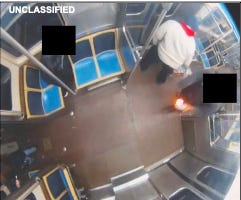
Chicago transit incident where a suspect used an accelerant to ignite a passenger inside a rail car. The case illustrates how easily common flammable liquids can be used to cause severe injury and panic in confined public transit environments.

Key Judgments:
Incendiary attacks on rail systems are a realistic threat to civilians in major urban areas.
The danger comes not only from the fire itself, but also from panic, trampling, smoke, and blocked exits.
Common consumer items such as gasoline, lighter fluid, or improvised containers can be enough to initiate an attack.
Attackers may not need a large casualty count to achieve psychological impact, public fear, and disruption.
Christians who travel for work, ministry, conferences, missions, or family reasons should treat rail systems as environments requiring active situational awareness.
Prepared citizens are more likely to survive these events if they identify warning signs early and move decisively before the crowd fully reacts.
What We Know
Recent cases in Chicago, Seoul, and Tokyo involved rail or subway attacks using flammable liquids or similar incendiary methods.
At least one recent case involved gasoline carried in a plastic water bottle.
These attacks were carried out in crowded passenger environments where escape options were limited.
The potential harm included burn injuries, smoke inhalation, crowd crush injuries, and injuries during emergency escape attempts.
Suspicious indicators associated with this threat include flammable liquids in unusual containers, strong chemical odors, unattended bags, and people transporting accelerants onto passenger systems.
JOIN US EACH WEEK FOR WARRIOR BIBLE STUDY. SIGN UP BELOW.

What We Do Not Know
We do not know whether these cases reflect a growing coordinated trend or simply a repeated tactic used independently by separate offenders.
We do not know whether copycat behavior will increase after media coverage of recent incidents.
We do not know which U.S. transit systems may face the highest short-term risk.
We do not know whether future attackers will combine fire with edged weapons, firearms, or secondary distractions.
We do not know how many civilians would recognize pre-attack indicators in time to move away or report them.
Indicators and Warnings
A person carrying a bottle, jug, or container that does not fit the setting, especially if it appears to contain liquid not normally brought onto public transit.
Strong odors of gasoline, lighter fluid, solvents, or other flammable chemicals coming from a person, backpack, or bag.
A person shielding or handling a container in an unusual way, especially while scanning the car or watching others closely.
Visible liquid spills followed by hurried movement, agitation, or attempts to ignite an object.
Tampering with fire safety equipment or unusual attention to exits, doors, or emergency features.
A person placing a suspicious bag and then moving away from it.
A sudden verbal outburst, fixation on a passenger, or abrupt movement toward a victim immediately before ignition.
Implications for Christians and Prepared Families
Families who rely on rail systems for commuting or travel should think through emergency movement before they need it.
Parents should understand that smoke and panic will likely be a greater threat to children than the attacker alone.
Ministry travel in large cities creates exposure to transit environments that many churchgoing families do not normally think of as threat spaces.
Christian preparedness should include public-space awareness, not just home defense and church security.
Believers should be mentally ready to protect loved ones, move with purpose, and help others when possible without freezing in confusion.
Recommendations
When boarding a train or subway, quickly identify exits, emergency intercoms, door locations, and any nearby escape options.
Avoid burying yourself in your phone. Keep your head up, scan the car, and notice who enters with bags, bottles, or odd containers.
If you smell fuel or chemical odors, do not dismiss it. Move away, alert transit staff if possible, and prepare to exit at the next opportunity.
Sit or stand where movement is easier. Do not trap yourself deep in a packed corner if other options are available.
Families should pre-brief simple commands such as “move,” “stay with me,” and “cover your face.”
If a fire starts, create distance immediately. Do not wait to understand everything before moving.
Cover your nose and mouth if smoke builds. Stay as low as practical while moving toward an exit.
Be prepared for crowd panic. The stampede can injure or kill people even if the fire is limited.
Carry simple trauma gear where legal and practical, especially items for burns, airway support, and bleeding control, but do not let gear replace awareness.
If you are forced to evacuate, move away from the rail car and continue assessing for secondary threats or additional attackers.
Practical Preparedness Takeaways
For the prepper audience, the lesson here is simple. Threats do not always look like a rifle attack or a large terror plot. Sometimes the danger is one disturbed or hostile person carrying a bottle of fuel in a crowded train car. Preparedness in public starts with awareness, positioning, movement, and a willingness to act early. Most people will be behind the curve because they are distracted.
Biblical Analysis
The biblical issue here is whether Christians live with disciplined awareness in a broken world while still reflecting the character of Christ. Scripture does not call believers to drift through life unaware of danger. It calls for clear thinking, self control, and concern for others when trouble appears.
Philippians 4:5 says, “Let your reasonableness be known to everyone.” In a crisis Christians should aim to think clearly and act with discipline. Panic spreads quickly in confined public spaces. A believer who keeps control of his mind and actions can guide family members, move toward safety, and help others without adding to the confusion.
Luke 10:36–37 reminds believers of the command to love their neighbor. In a public attack there may be moments when helping the injured becomes part of obedience. Survival and movement to safety may come first, but once a person is in a position to help, the Christian response is to care for those who are hurt, vulnerable, or unable to escape on their own.
Ecclesiastes 11:2 also offers wisdom that fits preparedness. “Invest in seven ventures, yes, in eight; you do not know what disaster may come upon the land.” The principle is simple. Wise people prepare for uncertainty. Awareness, planning, and readiness are part of living prudently in a world where sudden trouble can appear without warning.
Sources
Maryland Coordination and Analysis Center, MCAC Snapshot, Incendiary Attacks On Rail Systems Using Accelerants, March 2, 2026. This document is marked unclassified.
Associated Press, “Federal terrorism charge filed against a man who allegedly set a woman on fire on Chicago train,” published December 2025.
The Korea Times, citing Yonhap, “Police apprehend arson suspect in subway fire after hundreds escape through tunnel,” published May 31, 2025.
The Korea Times, citing Yonhap, “Court holds arrest warrant hearing for subway arson suspect,” published June 2, 2025.
Reuters, carried by Nippon.com, “Man dressed as Joker injures 17 on Tokyo train,” published November 1, 2021.
A corollary about which I heard some time ago: stop and go Rush Hour traffic. Leave space and be ready to drive or abandon as necessary/prudent. ABC and have certain items in one’s vehicle.
Response if doused with flammable liquid?