

Christian Warrior Training | Christian Warrior Bible Study
Our own government does not trust the power grid. On September 30, 2026, Secretary of War Pete Hegseth announced FORTRESS America, and internal Pentagon documents reported in October require every major base in the continental United States to run on its own electricity, water, fuel and communications for at least 90 days with no outside support. The plan calls for portable nuclear reactors, large battery storage and microgrids that let a base cut itself off from the civilian grid. Your house is not on that list, and if the grid goes down that long for the rest of us, people are going to die.
In February 2021, Winter Storm Uri took down the Texas grid and left millions of people without power for days in below-freezing weather. The Texas Department of State Health Services counted 246 deaths across 77 counties. Of those, 161 died from the cold, and most of the people who died of hypothermia were 60 or older. We are going into winter right now.

What the EMP Commission Told Congress
This is not a new warning. On July 10, 2008, Dr. William Graham, chairman of the Commission to Assess the Threat to the United States from Electromagnetic Pulse (EMP) Attack, testified before the House Armed Services Committee. His written statement said some critical parts of the electric grid are no longer made in the United States and can take up to a year to get. It said damage to those parts could keep significant pieces of the grid down for months to a year or more, and that the failures would spread from the grid into telecommunications, fuel, transportation, the financial system and the delivery of food, water and medical care.
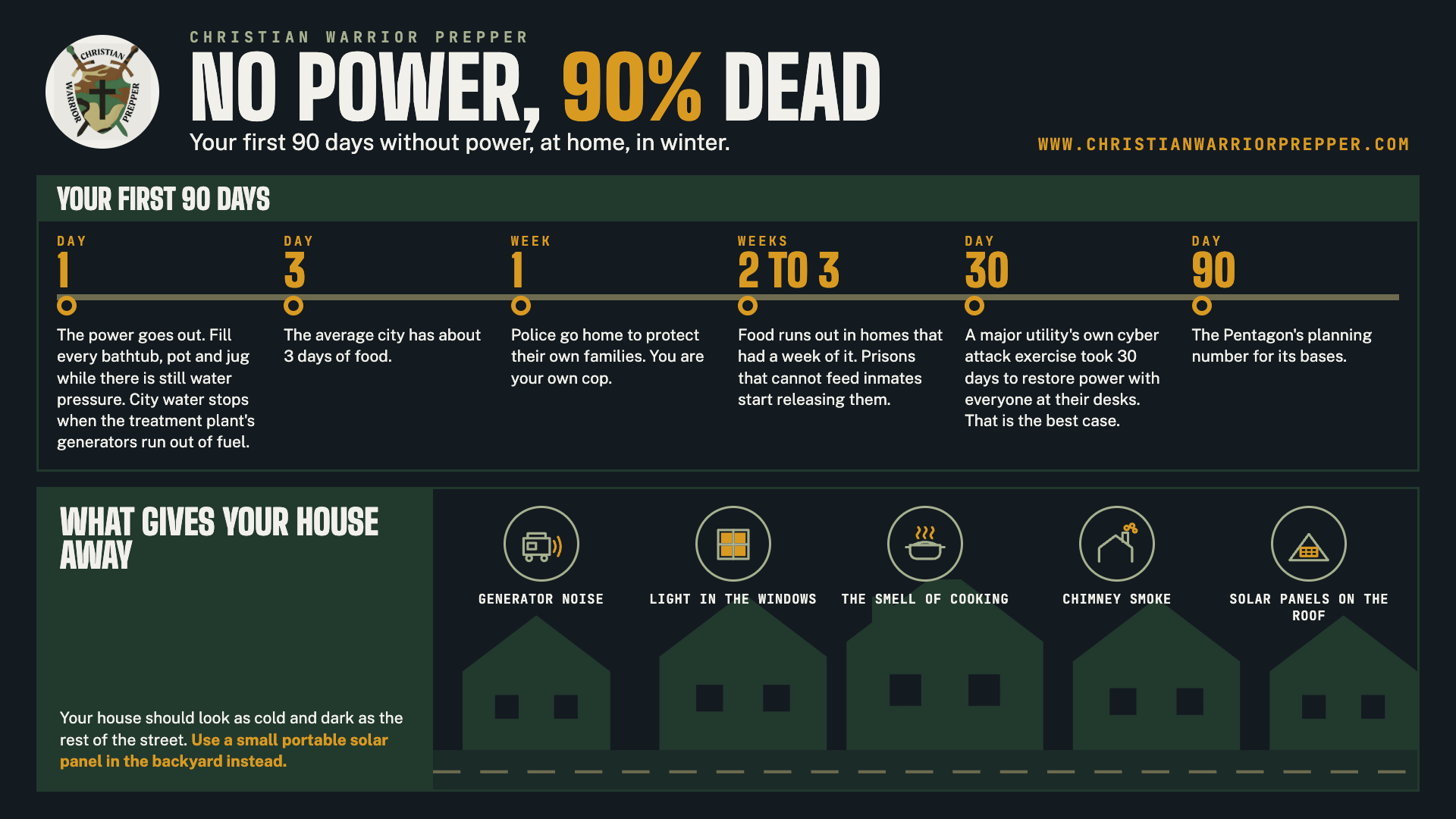
During questioning, Representative Roscoe Bartlett asked Graham whether the average city has about a three-day supply of food. Graham said that was about what the commission estimated. Bartlett then described a year without power ending with 90 percent of the population dead. Graham answered, “We think that is in the correct range,” and pointed out that the 10 percent left would be 30 million people living as a rural economy.
Graham also told the committee the same preparation would help with other threats the commission named, including a cyber attack and a large geomagnetic storm. An EMP is one way to lose the grid. There are others.
Thirty Days Is the Best Case
A friend of mine was an emergency manager for one of the largest electric companies in the United States. His company ran exercises where they simulated a cyber attack on their system. With everybody sitting at their desks, ready to go the moment it hit, it took 30 days to bring the entire system back online.
That number assumes a lot. It assumes the attack does not come in the middle of the night. It assumes that two weeks into the chaos, a lineman is willing to leave his family alone and drive to some remote mountain substation to flip a switch. That is not realistic. If 30 days is what the experts get under perfect conditions, 90 days is a reasonable number to plan around.

Live Like You Are Homeless in Your Own House
The Army taught me how to be homeless, and that is the mindset a family needs for this. You will still have a home. You just will not have anything that comes with electricity: no furnace, no stove, no refrigerator, no lights, and once the pumps stop, no water out of the tap.
A lot of people want a generator big enough to run the whole house so they can keep living the way they live now. But here’s the thing. A generator is loud. When every other house on the street has gone dark and quiet, people can hear it from blocks away. Everybody who is cold and hungry will know which house has fuel, food and power, and some of them will come to take it. You want to blend in, and your house should look like everybody else’s. That means you are going to be uncomfortable for a long time, and the sooner your family accepts that, the better they will handle it.
Warmth
It is winter, and cold is what killed people in Texas, so warmth comes first.
Live in one room. Pick an interior room with the fewest outside walls and windows. Everybody sleeps there. Hang heavy blankets over the doorways and cover the windows with blankets or rigid foam board. Covering the windows also keeps your light from showing outside at night.
Dress for it. Every person in the family needs a sleeping bag rated for cold weather, wool socks, a warm hat and layers. Sleep in the hat.
Heat safely. If you have a heater rated for indoor use, put a battery-powered carbon monoxide detector in the room with it and crack a window. In the Texas storm, 8 percent of the deaths were carbon monoxide poisoning, from generators, grills, charcoal and cars running in attached garages. None of those ever run inside the house.
Do the fuel math. This week, check how many hours your heater runs on one tank, then figure out how many tanks it takes to run it a few hours a day for 90 days. If you heat with wood, remember that a chimney putting out smoke tells the whole street you have heat.

Water
City water depends on electric pumps at the treatment plant and at the pump stations around town. Those plants have backup generators, and when the fuel runs out, the water stops.
The day the power goes out, fill every bathtub, pot and jug in the house. Plan on three gallons per person per day for drinking, cooking and basic washing. For 90 days that is 270 gallons per person, or 1,080 gallons for a family of four. Very few families can store that, so store at least 30 days if you can and know exactly where the rest is coming from. A rain barrel, a creek, a pond, a swimming pool and snow all count. Get a gravity filter to clean it, and keep unscented bleach or a way to boil water as your backup. Melting snow burns fuel, so count that too.
When the water stops, the toilet stops. A five-gallon bucket, heavy contractor bags and a bag of kitty litter will keep sanitation from making your family sick.
Food
Most families have less than a week of food in the house. Eat what is in the refrigerator first, then the freezer, then the pantry. In winter you can keep frozen food in a cooler outside or in an unheated garage as long as the temperature stays below freezing.
For the long haul, stock food that stores well and cooks easily: rice, beans, oats, pasta, canned meat, canned vegetables, peanut butter, honey and powdered milk. Count the fuel it takes to cook it. A pot of dry beans burns far more fuel than heating a can of chili, so keep a mix. Cook during the day and keep meals simple, because people down the street can smell cooking food.
If anyone in your house takes a prescription, work with your doctor now to get extra on hand. For emergency medications, OZIO Medical ships from Utah. Use ozio.com/christianwarriorprepper and code CWP10 for 10 percent off.
Light, Noise and Power
Light at night draws attention too. If yours is the only house on the block with light in the windows, people will notice. Use blackout curtains and headlamps and keep the light low.
If you live in town, skip the large solar install on the roof. It is one more sign that your house has power. A portable solar generator and a couple of panels you set out in the backyard during the day will keep radios, flashlights and phones charged, and nobody on the street has to know about it.
Security: Police, Prisons and Your Street
Police will stay on the job for about a week. Once it is clear the power is not coming back, they will go home to protect their own families, and I do not blame them. That leaves you as your own cop.
Then there are the prisons. I have four prisons within 40 miles of where I live. When the power is off and they cannot get food into those facilities, they are going to start releasing inmates into the surrounding communities. A lot of those inmates are hardened gang members, and gang members know how to organize. They will come together, and they will cause problems in your neighborhood. Look up the prisons and jails within 40 miles of your house and how far each one is from you.
One family cannot defend a house for 90 days, because sooner or later everybody has to sleep. Get together with your neighbors now and work out what you would do:
Who has medical training, who hunts, who has a well or a wood stove, who has small children, and who is elderly and will need somebody checking on them.
How you would watch the street at night in shifts.
Where you would meet and how you would warn each other.
If you have a readiness team, a grid-down is when you activate it and bring those skills together.
How to Get Your Neighbors Talking
Some of your neighbors will not want to talk about this, and some of them already think you are a little crazy. So do not start with an EMP or the end of the world. Start with winter, because everybody has been through a power outage.
Knock on the door and say something like, “If we lose power this winter, do you have a way to heat your house? Let’s trade phone numbers so we can check on each other.” Offer to help the older couple down the street get ready. Invite a couple of families over for coffee and bring up last week, when Microsoft, air traffic control, the big banks and United Airlines all went down within five days. Most people will talk about a storm long before they will talk about a collapse.
Look for the neighbor who is already halfway there, the one with the garden, the woodpile and the hunting truck, and have that conversation first. Then do the same thing at church. A street that has already traded phone numbers and agreed on a meeting place is in far better shape than one where everybody is meeting for the first time in the dark.
Communications
Cell towers run on backup batteries and generators, and when those run dry, so does your phone. You need radios, and you need a plan for how to use them.
Your street and your town: handheld Very High Frequency (VHF) and Ultra High Frequency (UHF) radios.
Family farther away: High Frequency (HF) radio.
Power: run everything on batteries you recharge with your portable solar generator.
Get your ham license so you learn the equipment and practice with it now. In a real emergency where lives are at stake, nobody needs a license to transmit. Then sit down with your neighbors and agree on which channel you use and a time every day when everybody checks in. Put it on paper and give everybody a copy.
What the Bible Says
In Ecclesiastes 4:9-12, Solomon writes that two are better than one, because they get a good return for their work. If one falls, the other lifts him up, and it goes hard for the one who falls with nobody there to help. If two lie down together they keep warm, but one person alone cannot. One person can be overpowered where two can stand, and a cord of three strands is not quickly broken. In a winter without power, a family keeps warm by sleeping in one room together, and a street holds against the people who come to take what it has when the neighbors stand together.
Proverbs 27:10 says a neighbor who is near is better than a brother who is far away. When the phones are down and the roads are bad, your brother three states away cannot help you, and the family next door can. God placed you on your street with those particular people. Paul tells us in Galatians 6:10 to do good to everyone as we have opportunity, and especially to the household of faith. Checking on the elderly couple, sharing water with the family that did not prepare and standing watch so others can sleep are all part of that.
In 1 Timothy 5:8, Paul writes that anyone who does not provide for his own household has denied the faith. Providing for your household in a 90-day grid-down means warmth, water, food and neighbors you already know. Our hope is in the Lord, and He expects us to use what He has given us to care for the people He put in front of us.
Final Thoughts
Your family needs warmth, water, food, security and communications for 90 days without power, and the work starts this week with the fuel math and a knock on your neighbor’s door. Tell me in the comments how your neighbors reacted when you brought it up, or how many days of fuel you found you actually have.
FREE DOWNLOADS👇

For Paid Subscribers
✅ Analyst’s Notes: why 90 days is the planning number, and what the cyber exercise leaves out
Excellent article. Best ever on what could happen if/when we're attacked. My sister was in the Texas shutdown. She and her husband nearly froze to death due to lack of resources and preparation.