

Most people imagine a terror attack as one attacker with one weapon in one location. That model is too simple.
Real attacks can involve several methods and several phases. A vehicle may be the first weapon. An explosion may drive people into the open. Gunfire may begin after the crowd starts running. In some cases attackers hit several locations at once, or one attack pushes people directly into another danger area.
When that happens the problem looks very different from the lone gunman scenario people usually picture. You may be dealing with confusion, injured people, blocked exits, and police moving rapidly toward the scene. The place that feels safe at first may not actually be safe.
Your goal is not to stop the attack. Your goal is to get yourself and the people with you out of the danger area alive.

Stop Thinking the Attack Ends With the First Event
In a layered attack the first event may only be the beginning. A vehicle attack may be followed by gunfire. An explosion may be followed by another device or another attacker.
Instead of focusing on what just happened, focus on what could happen next.
If a vehicle just drove into a crowd, do not assume the threat is over because the vehicle stopped. If there has been an explosion, do not assume the area nearby is safe. If everyone around you is running in one direction, do not assume the crowd knows where safety is.
Panic spreads faster than accurate information.
Think in layers. Look for cover. Look for exits. Look for the possibility of another attacker. Keep moving until you are clearly outside the hazard area.
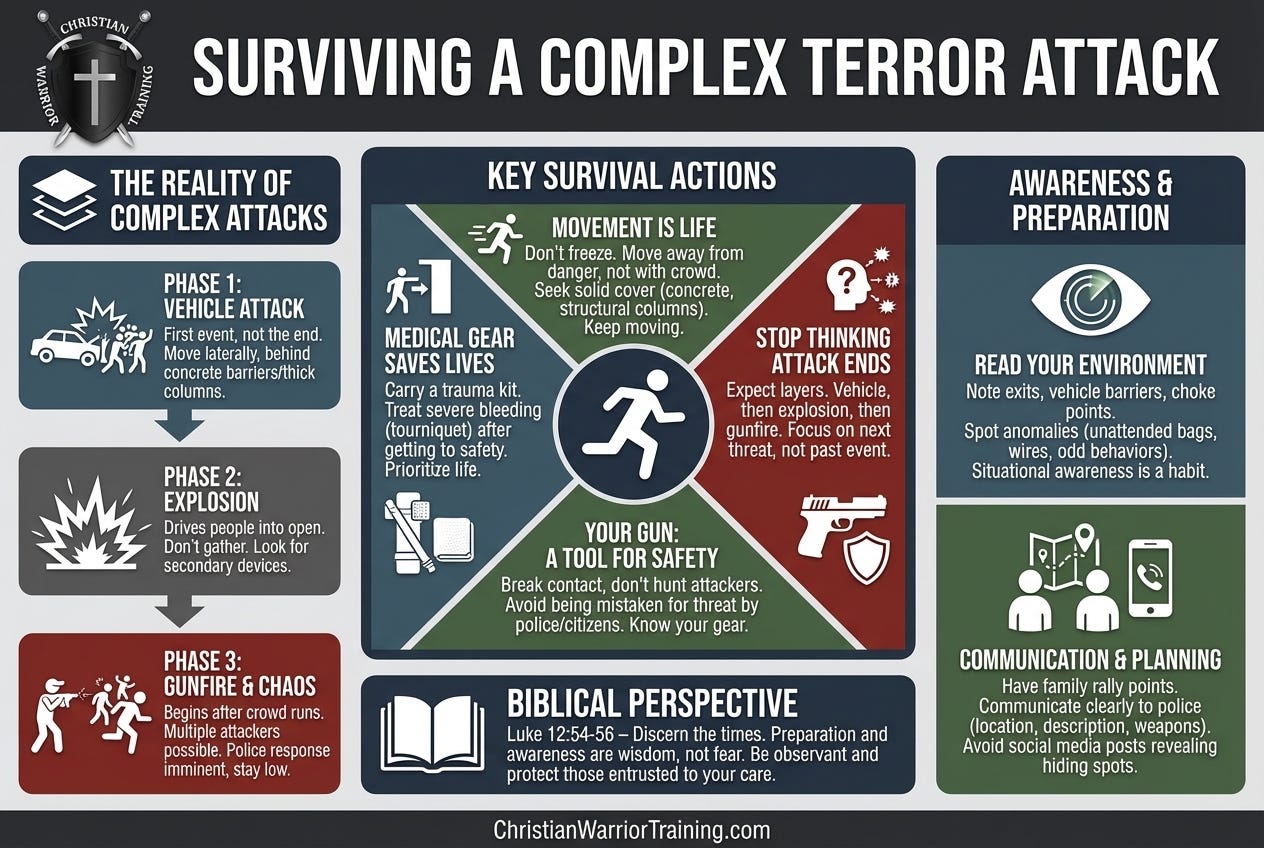
Movement Is Life
In most cases your best option is movement. That movement must be deliberate.
If a vehicle is bearing down on you, move laterally. Do not try to outrun it straight ahead. Vehicles are faster than people. Get behind something that can stop a moving vehicle such as large concrete barriers, heavy planters, thick structural columns, or the corner of a solid building. A parked car will not reliably stop a speeding vehicle.
If you move inside a building, get well inside and away from entrances and glass. Vehicles can travel farther than people expect once they crash through doors or windows.
If you are caught in a crowd, work toward the edges instead of letting the crowd carry you. Face the direction you want to move and protect your balance. Move diagonally when possible and avoid pushing directly against the flow. Look for service exits, side corridors, or alternate routes rather than funneling into the same doorway everyone else is using.
Do not stop at the first place that feels quieter. Stop when you are confident you are outside the attack pattern.

Your Gun Is a Tool to Get to Safety
A firearm can be useful in a crisis, but it is not a counterterror strategy.
In a large chaotic attack you may be dealing with multiple attackers, different weapons, and a police response arriving quickly. Your firearm is primarily a tool to break contact if someone blocks your path to safety.
Trying to hunt attackers in a crowded environment is extremely dangerous. You could be killed by another attacker you did not see, or mistaken for the attacker by responding officers or another armed citizen.
Carry reliable equipment and train with it. If you carry a handgun you should be able to deploy it quickly and make accurate hits under stress. If you cannot do that, the gun will not solve the problem by itself.
Also remember that a handgun or rifle will not stop a moving vehicle.
Medical Gear Often Saves More Lives
Severe bleeding is one of the most common preventable causes of death in violent incidents.
A small trauma kit can make a significant difference. A tourniquet, compression bandage, gauze, and shears take very little space but can keep someone alive until professional help arrives.
If you are able to move after an explosion or attack, your first step is still to leave the immediate danger area. Once you are outside the kill zone you can address life threatening bleeding.
If a loved one is wounded but can be moved, getting them away from the scene may be the most important action you take.
Learn to Read Your Environment
Preparation starts before anything happens.
Pay attention to your surroundings. Notice exits. Notice barriers that could stop vehicles. Notice choke points where crowds might pile up.
Watch for things that are out of place. A vehicle where vehicles should not be. A bag left somewhere unusual. Someone placing an object and quickly leaving. Wires or containers that clearly do not belong where they are.
Situational awareness is a learned habit. The more you practice looking for exits, cover, and potential hazards, the more natural it becomes.
Communication During Chaos
During major emergencies cell networks often become overloaded. Everyone tries to call at once.
Families should have simple plans before entering crowded environments. Choose rally points. Decide where you will meet if separated. Know the name of the venue and nearby streets.
If you need to report information to police or emergency dispatchers, clear information helps. Describe what happened, where you are, what the suspect looked like, what direction they moved, and what weapons you saw.
If you are hiding from an active threat, avoid posting photos or videos that reveal your location. Public information can expose hiding places and responder movements.

Planning Ahead
The easiest attack to survive is the one you never walk into.
Large public gatherings such as festivals, concerts, parades, and crowded entertainment districts create attractive targets for attackers. That does not mean you stop living your life, but it does mean you should think ahead before going.
Look for vehicle barriers. Identify multiple exits. Decide where you would move if something happened. Think about how you would leave if the main route was blocked.
People who mentally rehearse possible emergencies often make better decisions when something actually happens.
Biblical Perspective
Christians are not called to live in fear, but we are expected to pay attention to the world around us.
Jesus addressed this directly in Luke 12:54–56:
“When you see a cloud rising in the west, you say at once, ‘A shower is coming.’ And so it happens. And when you see the south wind blowing, you say, ‘There will be scorching heat,’ and it happens. You hypocrites! You know how to interpret the appearance of earth and sky, but why do you not know how to interpret the present time?” (ESV)
Christ was pointing out that people are capable of recognizing signs in the natural world, yet many fail to recognize the dangers or important events unfolding around them.
The same principle applies to personal safety and preparedness. Paying attention to warning signs, observing your surroundings, and preparing for danger is not paranoia. It is discernment.
Christians should not move through the world blindly. We are called to be observant and wise about the times we live in. When danger appears, wisdom means recognizing it early and taking action to protect the people God has entrusted to our care.
Preparation is not about fear. It is about seeing clearly and acting wisely.

Conclusion
A distributed terror attack is a survival problem built on awareness, movement, and preparation.
The first attack may not be the only attack. The nearest shelter may not be safe. The crowd may not know where safety is.
Your priorities are straightforward. Move away from danger. Use solid cover. Keep your family together if possible. Stop severe bleeding. Communicate clearly.
Preparation done before a crisis allows you to act decisively when seconds matter.
The only time I’ve ever wore hard armor was doing raids or swat operations. I wear soft armor when I’m working at church. I’ve never had to explain any of this to my church leadership. My pastor wears it when he is on stage.
Wisdom and preparedness from a Christian perspective - common sense that is very uncommon. Thank you!