Christian Warrior Training | Christian Warrior Bible Study
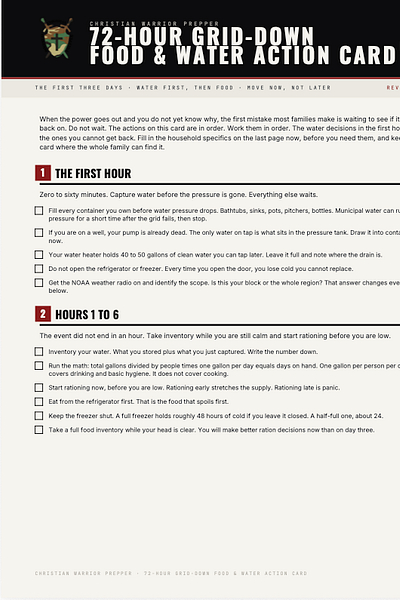
Free subscribers get the 72 hour apocalypse plan download, while Paid subscribers get the comms plan and water/food planning checklists. It’s at the bottom of this article. Thank you for supporting Christian Warrior Prepper!
📺 Watch the Full Video Briefing on YouTube
The most dangerous man in the preparedness world is the one standing in his garage looking at two years of food, four rifles, and nobody to hand one to. He has confused inventory with capability. In an extended emergency he will be awake for the first seventy two hours running his own security, his own medical, his own water treatment, and his own decision making, and somewhere around hour ninety he will make the mistake that ends it. Not because he was untrained. Because no one person can hold a perimeter, treat a wound, and sleep at the same time.
This is the part of preparedness almost nobody teaches, because gear sells and community does not. So let us fix it. What follows is the structure I want you building before the end of this year: ten people, two Elements, ten assigned specialties, and every one of them cross-trained. I call it a Readiness Team.

Why Ten, and Why Two Elements
Ten is not an arbitrary number. It is the smallest group that can sustain a twenty four hour operation and still lose a member without collapsing. Five people can cover the specialties, but five people cannot run a rotation. Somebody has to sleep. Somebody will get sick. Somebody will be at work when it starts.
Ten also splits cleanly, and that is the real reason for it. A Readiness Team of ten is organized into two Elements of five. Each Element has a leader. Above them sits one team leader. That is the structure the American military has used for a very long time, for a very simple reason. It lets the group divide when the situation requires it and still have both halves functional.
Think about what dividing actually means in practice. One Element stays with the property while the other moves to bring in a family member stranded across town. One Element takes the night watch while the other sleeps. One Element handles a medical evacuation while the other maintains the water and the security posture at home. A flat group of ten with no internal structure cannot do any of that. They will argue about it in the driveway while the clock runs.
The Ten Assignments
Every person on the Readiness Team owns one specialty. Owning it means you train for it, you buy for it, you maintain it, and when the group needs that thing, everyone looks at you. You are not buying for yourself. You are buying for ten.
Team Leader. Holds the plan, makes the call when the group is split on a decision, and is responsible for the readiness of both Elements. Not the loudest person. The one who thinks clearly when other people are not.
Medical. Trauma care first, then chronic and routine. Owns the group trauma kits, the medication inventory, and the thirty day prescription reserve for every member. Knows who is diabetic, who carries an EpiPen, and who is on a blood thinner.
Weapons and Security. Owns the defensive plan, the perimeter, the watch rotation, and the training standard. Maintains the group’s arms and ammunition accounting.
Communications. Owns the written communication plan, rally points, radio inventory, and licensing. Runs the layered system: cell phone first, VHF second, HF third. Sets the check in schedule and enforces it.
Logistics and Supply. Owns the inventory. Knows what the group has, where it is, and when it expires. Runs rotation and resupply. This is the position that keeps a three thousand dollar food investment from spoiling untouched in a basement.
Food Production. Owns growing, preserving, canning, hunting, and stretching. The difference between thirty days of stored food and an indefinite food supply is this person.
Sanitation and Water. Owns treatment, waste handling, and hygiene. Nobody wants this job. Historically, disease has killed more people in a crisis than violence has, and it does it quietly, through a group that got sloppy with its hands and its latrine.
Power and Mechanical. Owns generators, batteries, solar, fuel storage, vehicles, and repair. Every other specialty on this list depends on power or a working truck, and almost no group assigns anyone to it.
Chaplain. Owns the spiritual life of the group. Leads worship, opens the Word, provides counsel, and carries the group through grief and fear. This is a manned position, not an afterthought. In an extended crisis the first thing to break is not the generator. It is the people.
Training and Intelligence. Owns the drill schedule and the cross training plan. Makes sure the medical person can work a radio and the sanitation person can put on a tourniquet. Runs the group’s dry runs and makes them uncomfortable enough to be worth something. When conditions change, this is also the person reading the local situation and telling the team what is developing before it arrives. The two halves of the job rarely collide, because drills happen in the quiet and monitoring happens when the quiet ends.
Now split those ten across two Elements. Balance them so that each Element has someone who can shoot, someone who can treat a casualty, someone who can talk on a radio, and someone who can pray. The Element leaders come from within those five, not from outside. When you build the split, look at what each Element could not do if it operated alone for seventy two hours, and cross train against that gap first.

Cross Training Is the Whole Point
Assignments are how the work gets divided. Cross training is what keeps the group alive when the assignment holder is the casualty.
Every specialty has a primary and an alternate, and the alternate sits in the other Element. Your medical person is in First Element, so your alternate medical is in Second Element. If the two halves are separated when something goes wrong, both halves can still stop a bleed. Apply that rule down the entire list and you will have a group that degrades instead of collapsing.
Here is the standard I want you to hold. Every member should be able to perform the basic function of every other specialty at a survivable level. Not an expert level. A survivable one. Everyone can apply a tourniquet. Everyone can key a radio and give a location. Everyone can shut off a water main and treat a container of water. Everyone can run the generator. The specialist takes it from there.
That is the training coordinator’s whole job, and it is why that position exists. Left alone, every preparedness group in America trains on the one thing its members already enjoy, which is shooting, and neglects the nine things that will actually determine whether they make it.
Who Is On It, and How They Get There
Your Readiness Team comes from your family, your neighbors, your friends, and your church. That is the order most groups form in and it is a reasonable one.
They do not all have to be believers. I want to say that plainly because it will come up. If the Lord puts a man across the fence from you who can weld, who is steady under pressure, and who does not yet know Christ, you do not exclude him. You bring him in and you live in front of him. A Readiness Team is one of the most honest evangelism opportunities you will ever have, because the people in it will see you at your worst and under real pressure, and if your faith holds up there, they will ask you about it. The chaplain position is not there to make everyone Christian by rule. It is there to make sure Christ is present in the room.
Recruiting happens by word of mouth and nothing else. There is no application. There is no post on the community page. You talk to a man you already know, over time, and you watch how he handles small things before you ever raise the subject of large ones. Does he show up when he says he will? Does he keep his mouth shut about other people’s business? Can he take correction without getting his feelings hurt?
You have to trust these people explicitly, because the moment you invite someone in you have told them what you have and where it is. That knowledge cannot be recalled. So the standard is not whether you like a person. The standard is whether you would hand him your rifle and turn your back.
Information gets released in stages. Before a person commits, they know the concept and the people. They do not know your inventory, your caches, your rally points, or your full plan. After they commit and have trained with the group, they know what they need to know to do their job. Nobody outside the Readiness Team knows anything. That is not paranoia. Your neighbors are wonderful people right up until their children have not eaten for two days, and then they are going to remember every word you said about your basement.
My own team is a mix of family, friends, and neighbors. It did not get assembled at a meeting. It accumulated, one relationship at a time, over years of ordinary life, and most of the people on it were on it long before anyone used the word team out loud. That is worth understanding if you are starting from nothing today. You are not recruiting strangers into a plan. You are recognizing the people already standing around you and giving the arrangement a shape it did not have before.
The Leadership Problem Nobody Wants to Touch
Most Christian preparedness groups avoid the leadership question because it feels unspiritual to say out loud that somebody has to be in charge. Then a crisis arrives and ten people with equal standing spend the first four hours voting.
Somebody leads. The group decides who before anything happens, and once the group decides, that is the man. The Element leaders report to him. He does not become a tyrant and the structure is not a license for ego. He carries the responsibility for the group’s readiness and he makes the call when the group is split and the clock is running.
Choose him on judgment, not on rank, wealth, or who owns the property. The best team leader I ever worked under was not the loudest man in the room and he was not the best shooter. He was the man who slowed down when everyone else was speeding up.
What Scripture Says About This
The structure I have described is not a modern invention. It is in the Word, and it is older than the United States Army.
In Exodus 18, Moses is trying to judge all of Israel by himself. His father in law Jethro watches him do it for one day and tells him plainly that he is going to wear himself out, and the people with him, because the thing is too heavy for one man. Then he tells him how to fix it.
“Moreover, look for able men from all the people, men who fear God, who are trustworthy and hate a bribe, and place such men over the people as chiefs of thousands, of hundreds, of fifties, and of tens.” (Exodus 18:21, ESV)
Chiefs of tens. That is a squad leader. Notice what the qualifications actually are. Able, God fearing, trustworthy, and unwilling to be bought. That is a character list, not a skills list. Notice also that Jethro’s correction is delegation and structure. Moses was faithful and he was still wrong, because a good man doing everything himself is a good man about to fail.
Paul makes the second half of the argument in 1 Corinthians 12, where he describes the church as a body with many members and different functions, none of which can look at another and say it has no need of it. The hand does not do the eye’s job. The specialties are not a ranking. They are how a body works, and a body with only hands is not a stronger body. It is a corpse.
And in Nehemiah 4, when the wall was under threat, Nehemiah did not tell the people to pray and stop working. He set a guard, he armed the builders, he stationed families by clans with their swords and their spears and their bows, and he put a man with a trumpet beside him so the scattered work parties could rally to the sound. That is assigned positions, a communications plan, and a rally point. Nehemiah built a Readiness Team, and he did it while the wall was going up.
Preparation is not the opposite of faith. It never was.
Start This Week
Write down ten names. Not ten people you like. Ten people you would trust with your family, ranked by that standard alone. You will find that the list is shorter than you expected, and that is the most useful thing this article will do for you.
Then make one call. Not to pitch a bunker. Just to have coffee with the first man on the list and ask him what he would do if the power went out for two weeks. Listen to his answer. That conversation is the first drill.
The lone prepper is not strong. He is exposed, and he has confused a full garage for a plan. Build the team.
If this was useful, leave a comment below and share it with your family or the people you are thinking about putting on that list of ten.