

Facebook | X | Instagram | YouTube | LinkedIn | Threads | TikTok
FREE DOWNLOADS AT THE BOTTOM OF THE ARTICLE
BLUF
I was recently given a government threat bulletin that was distributed to law enforcement and security partners, not to the public. It warns that nihilistic violent extremist networks are encouraging their members to set forest fires, and it comes at the start of one of the driest fire seasons the West has seen. If you live in or near fire-prone country, you should assume that some fires this season will be set intentionally and that your warning time may be short. Harden your property, stage your evacuation gear now, and make sure you can communicate without a cell tower.
Key Judgments
Highly Likely: Nihilistic violent extremist networks will continue promoting arson, including wildfire arson, through the summer.
Likely: At least one significant wildfire in the Western United States this season will have a confirmed or suspected extremist connection.
Likely: Intentionally set fires will be started in conditions that favor rapid spread, which shortens warning and evacuation time.
Possible: Families in wildland-urban interface areas will face an evacuation decision this season with little or no official notice.
The Threat in Plain Terms
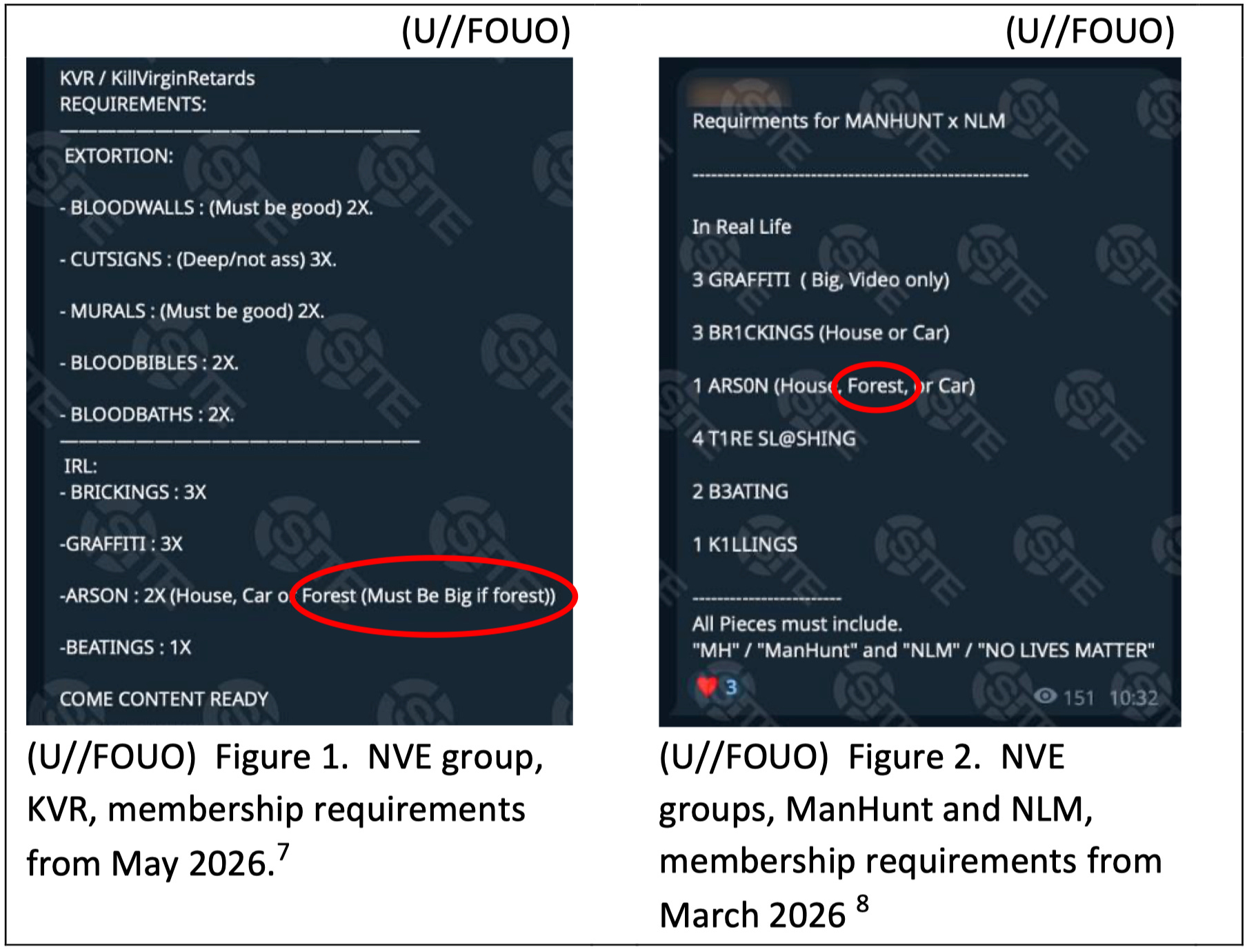
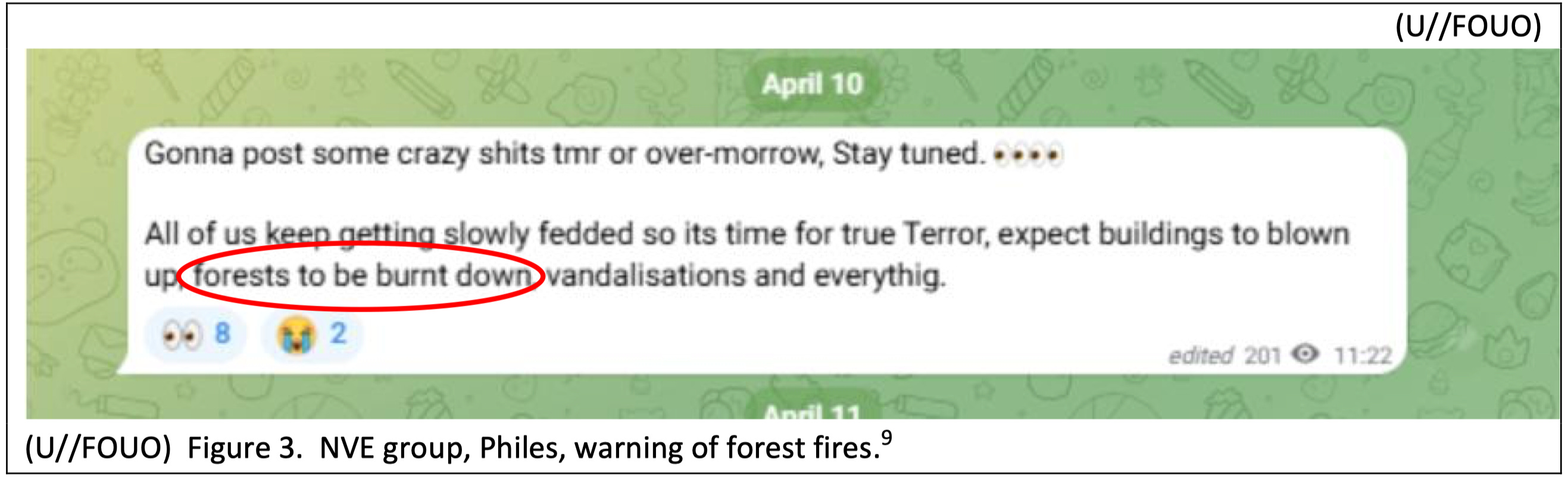
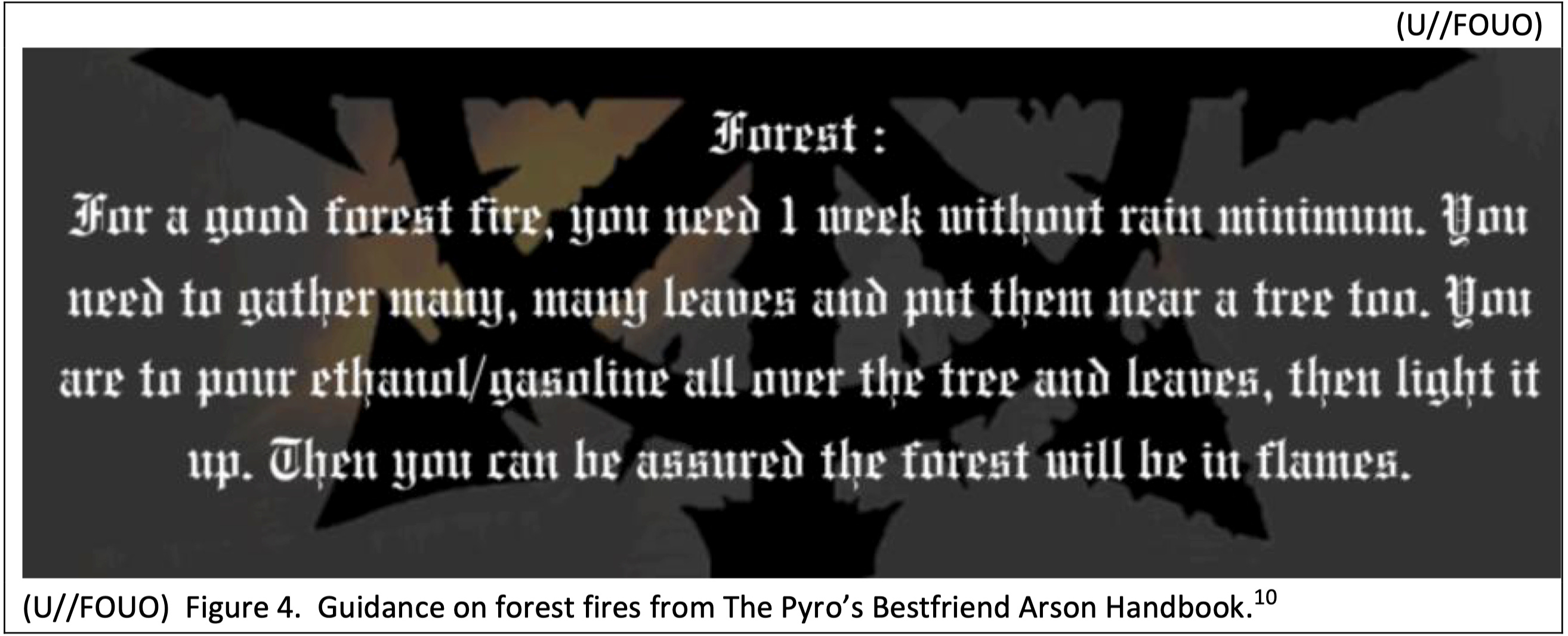
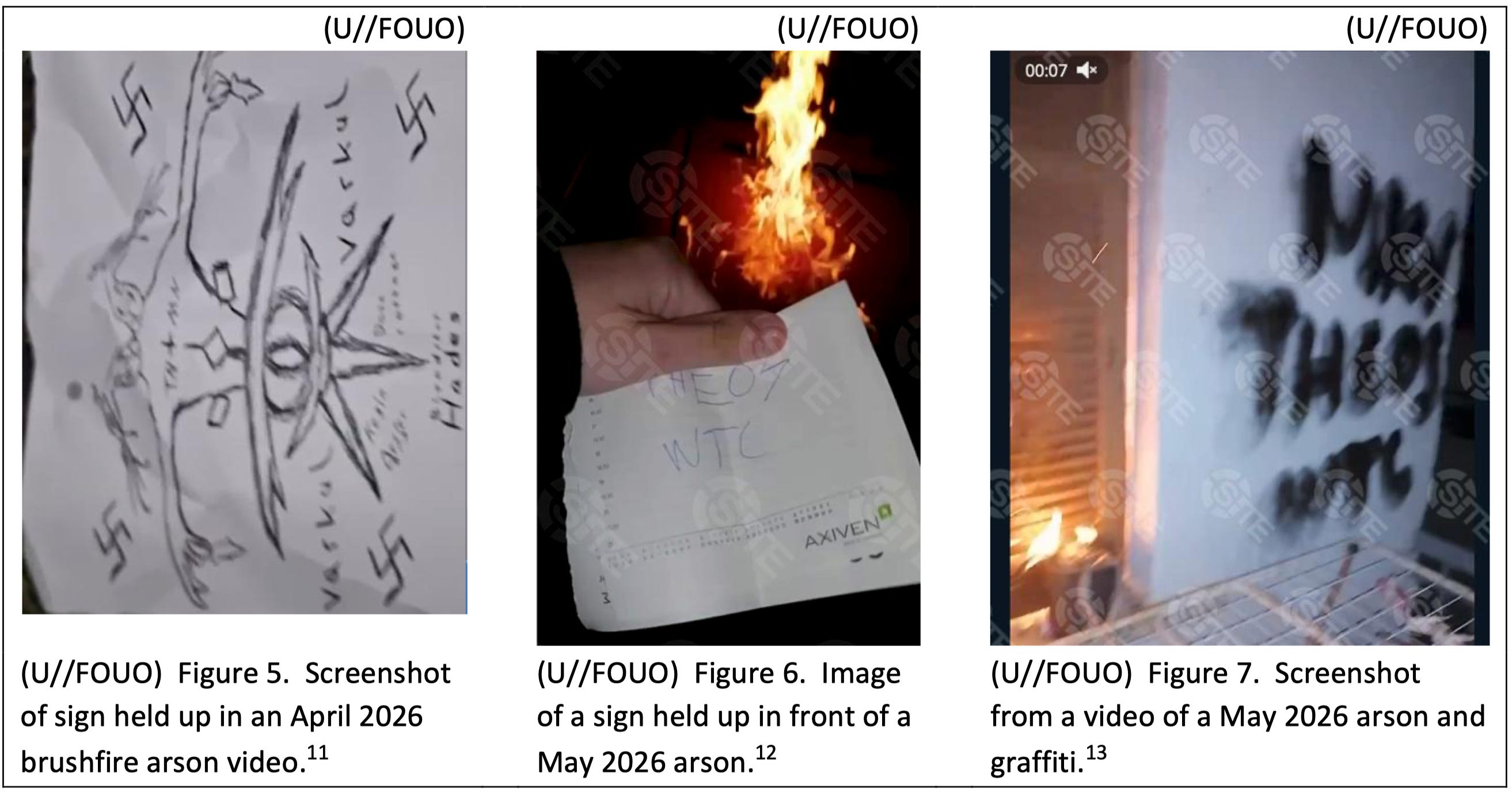
Nihilistic violent extremists, called NVEs in government reporting, are not driven by politics or religion. They commit violence for its own sake. These networks operate anonymously online, recruit young members, and require documented acts of violence and arson as a condition of membership. Over the past few months, several of these groups added forest arson to their membership requirements. One group released video of a member setting a brushfire that spread into a wooded area. Another publicly stated that forests would be burned. At the end of May, an arson manual that names forests as a target began circulating in these channels. I am not going to describe what is in it, and you do not need to know. What you need to know is that the material is out there, the people reading it have already acted, and setting a fire in drought conditions takes no skill.
The timing is what concerns me. Colorado declared a statewide Drought Emergency on June 4. Nearly 93 percent of the state is in moderate to exceptional drought after the lowest snowpack season on record, and much of the Mountain West is in similar shape. In a wet year, a fire like this stays small. In a year like this one, it can take a town.
Harden Your Property Now
If your home is in the wildland-urban interface, start with defensible space, and do it now while there is time. Cut brush back from your structures. Remove dead vegetation and anything that lets fire climb from the ground into the trees. Clean needles and leaves out of your gutters and off your roof. Move firewood away from the house. Keeping the first five feet around the structure clear of anything that burns gives your home a much better chance of surviving blowing embers, and embers are what take most homes.
After that, look at active protection. Roof and perimeter sprinkler systems that you can turn on as you leave will soak the structure and the ground around it, and they have saved homes in past fires. If you have a pool, a pond, or a stock tank, a gas-powered portable fire pump and a couple hundred feet of fire hose gives you the ability to wet your perimeter and knock down spot fires while the main fire is still at a distance. Add hand tools to that: a chainsaw, a good rake or a McLeod, and a shovel. Understand what this equipment is for. It buys your home a chance while you get your family out. It is not a reason to stay and fight a crown fire. When it is time to leave, leave.
The Five-Minute Bug-Out
A fire set on purpose in drought fuels can move faster than the official warning system. Your standard should be a five-minute departure. From the moment you decide to go, everyone and everything essential is loaded and the vehicle is moving within five minutes. The only way to meet that standard is to stage ahead of time. Keep documents, medications, cash, spare keys, and irreplaceable items in one container you can grab. Keep bags packed through fire season. Keep vehicles above half a tank and parked facing out. Give every member of the family one job in the load-out, including the kids, and rehearse it with a stopwatch. The first rehearsal will show you what you got wrong, which is the reason you rehearse.
Plan two routes out in different directions, because fire or traffic will close one of them. Pick a rally point outside the threat area in case the family is separated when it starts. Sign up for your county’s emergency alerts, but do not depend on them. The fires this bulletin warns about may not come with a notification.
Communications When You Have No Cell Coverage
If you spend time in the backcountry, or your home sits outside reliable cell coverage, put a ham radio in your kit this season. A handheld transceiver programmed with your local repeaters will get a report out from terrain where a phone will not. FCC rules allow anyone to transmit in a genuine emergency involving immediate threat to life or property, license or not. That exemption exists for real emergencies. It is not a substitute for getting your Technician license and learning your local repeater network now, while nothing is burning. A man who has never keyed that radio before is going to struggle with it under stress. Program the repeaters, learn the basic protocol, and carry the radio when you go into the woods this summer. Reporting a fire in its first ten minutes, before it gets into the canopy, may be the most useful thing a private citizen can do this entire season.
If You Witness
Arson in Progress
Now the hard scenario, and I want you to do more than read this. I want you to rehearse it in your mind, because you may be the only person in that forest.
You are hiking, hunting, or cutting wood, and you see a man setting a fire. If the first time your brain runs that picture is the moment it happens, you will lose seconds to disbelief. So run it ahead of time the way we trained it on the job. When I see ignition, I move to cover and distance. When I am behind cover, I start building my witness picture. When I have what responders need, I get the report out. Decisions made ahead of time are what separate the man who acts from the man who stands there watching it burn.
Cover and distance come first, every time. A person willing to burn a forest has already shown you what kind of man he is. These networks tell their members to expect confrontation, and you have no way of knowing what he is carrying. From a position of advantage, build your witness picture. Physical description from the ground up. Clothing. Vehicle, plate, and direction of travel. Exact location. Photograph or video from a position he cannot reach quickly. These offenders film their own attacks for status in the group, and your footage may be the evidence that convicts him. Then get your report out, by phone if you have signal and by radio if you do not, and stay available for responders.
There is a deeper question you need to settle before you ever lace up your boots. Would you intervene, and where is your line? Work through it at the kitchen table with a clear head, because you will not think clearly watching fire move through dry timber. Know your state’s law. In most states a citizen may use reasonable force to stop a violent felony in progress, but deadly force in defense of property alone is unlawful almost everywhere, and citizen’s arrest statutes vary a great deal from state to state. Then weigh the situation honestly. You are alone, out of cell range, dealing with an unknown subject, and the fire he just lit is growing behind you. Every minute you spend on him is a minute the fire goes unreported. Your training, your physical condition, who is with you, and your conscience all factor into where your line is, and I cannot draw it for you. I will tell you what I know after a career of taking people into custody. The fire is what kills people. The fastest way to stop it from killing people is early detection and an accurate report. The witness who puts the suspect in front of a prosecutor has stopped him just as completely as the man who went hands-on, and he carries far less risk doing it. Think it through now, decide where your lines are, and pray you never need them.
Threat Assessment
The overall threat level for prepared families in drought-affected Western states is ORANGE, high, through the end of this fire season. For the rest of the country the level is YELLOW, elevated, based on the broader extremist arson trend against structures and vehicles rather than wildfire specifically.
It is highly likely that these networks will continue calling for and attempting wildfire arson through the summer. The cost to them is nothing and the destruction is enormous, and that combination is exactly what draws them. It is likely that at least one major fire this season will have an extremist connection, though confirming it may take weeks or months because fire destroys most of its own evidence. It is also likely that intentionally set fires will be placed and timed for maximum spread, which means families should expect less warning than they would get from a lightning start or an escaped campfire. The primary concern for this audience is a fast-moving fire reaching homes and escape routes ahead of official evacuation orders. The secondary concern is the backcountry encounter, the hunter or hiker who comes upon ignition in progress and has to make sound decisions under pressure. Families in the wildland-urban interface should treat this season as a heightened readiness period. Defensible space should be cut now, water and pump capability staged, the five-minute drill rehearsed, and communications proven before they are needed.
Biblical Lens
The prudent sees danger and hides himself, but the simple go on and suffer for it. — Proverbs 27:12 (ESV)
And we prayed to our God and set a guard as a protection against them day and night. — Nehemiah 4:9 (ESV)
Scripture treats preparation as wisdom, not as a lack of faith. The prudent man sees what is coming and acts before it arrives. Nehemiah’s people prayed and posted a watch at the same time, because the threat was real and the work still had to get done. This summer calls for the same approach. Trust God, and cut the brush, stage the bags, and carry the radio.
Leave a comment and tell me what your fire season preparations look like, and share this brief with your family and your preparedness group. The families that handle this season well will be the ones that did the work early.

Keith, I am a Wildland Firefighter stationed in Santa Clarita, CA. Working for Angeles National Forest. You are right, great video and God Bless you for helping people out with your knowledge from experience. Ive been following you for some time now, really support what you do! I am also Lead Security for my Wife’s and I’s church in Burbank CA. That has been going exceptionally well as a result of your hard work and dedication to this ministry. thank you.
The government has been aware of the terrorist threat of wilfires since around 2012. But, so many of my neighbors in Nor Cal mountains look at me like I've grown a second head if I mention it. Here's a video from 2014 discussing this threat.
https://youtu.be/7pqALAhzpgM?is=MWo6NwklUFRVHoW5